



CJC-1295 & Hexarelin: How a GHRH Analog and a Growth Hormone Secretagogue Stimulate GH Signaling
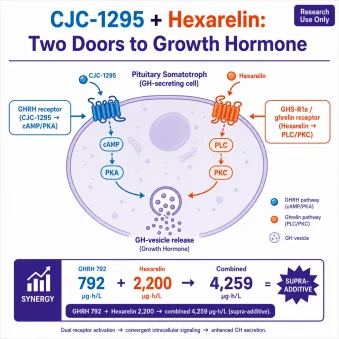
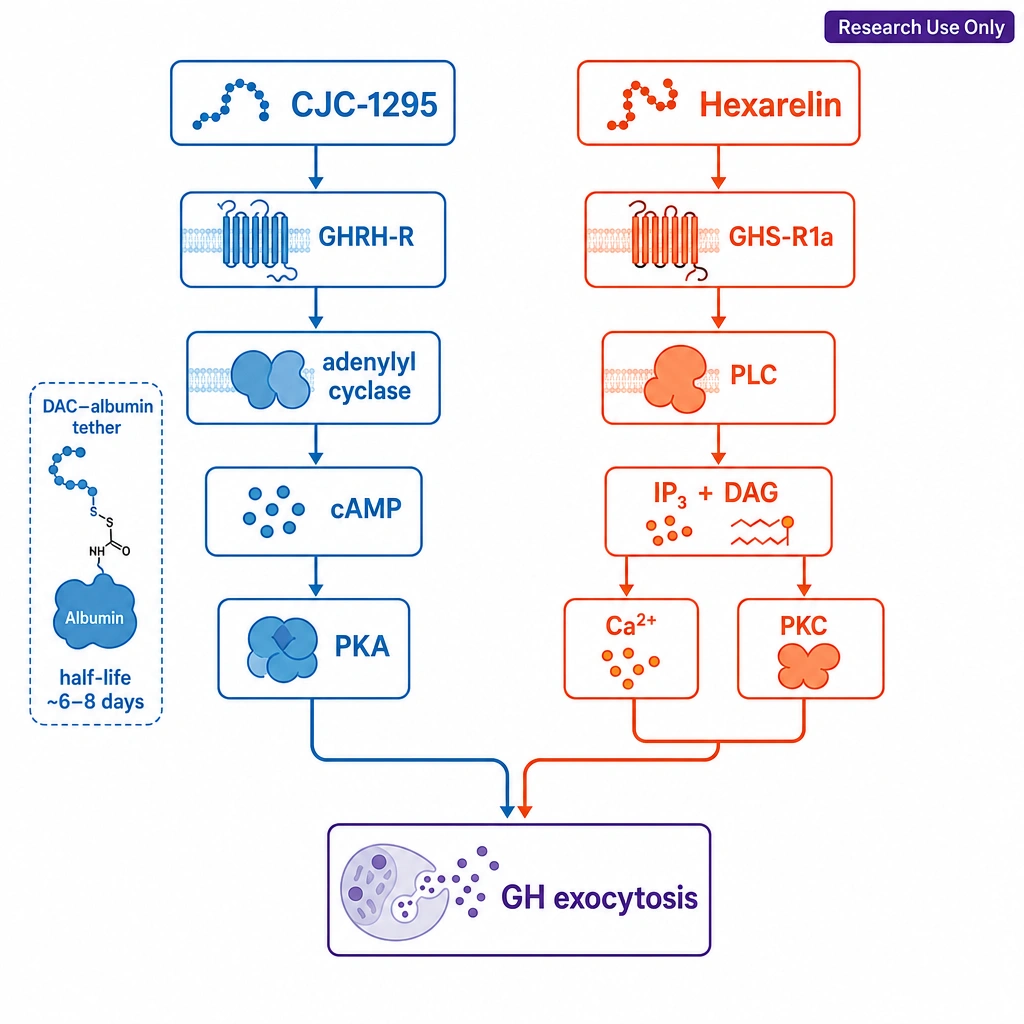
CJC-1295 and Hexarelin are studied together because they push the same cells within the pituitary gland to release growth hormone (GH) through two different doors. CJC-1295 is a long-acting GHRH analog that works via the cAMP/PKA pathway; Hexarelin is a growth hormone secretagogue that works via the ghrelin/GHS-R1a and PLC/PKC pathway. This research-use-only review explains each mechanism, the numbers behind their GH and IGF-1 output, why co-exposure is hypothesized to be synergistic, and Hexarelin's separate action on cardiac CD36.
Research-use-only disclaimer: CJC-1295 and Hexarelin are intended strictly for in-vitro and laboratory research use. They are not drugs, supplements, or therapies, and they are not intended for human or veterinary use. Every finding below is drawn from cell-culture or animal models and is described in hedged, mechanistic terms. Nothing here is medical advice.

TL;DR
CJC-1295 (a DAC-albumin-bound GHRH analog) and Hexarelin (a ghrelin/GHS-R1a secretagogue) stimulate pituitary somatotrophs through complementary pathways: cAMP/PKA versus PLC/IP3/PKC. CJC-1295 with DAC has a multi-day half-life; Hexarelin adds a rapid secretagogue pulse. Combining a GHRH agent with a GHS is reported to be supra-additive (Arvat et al.). Hexarelin also acts on cardiac CD36 independently of GH. Research use only.
Two receptors: CJC-1295 → GHRH receptor (cAMP/PKA); Hexarelin → GHS-R1a (PLC/IP3/PKC).
CJC-1295 DAC: maleimidopropionamide group tethers it to albumin, extending half-life beyond 72 h (~5.8–8.1 days).
Output: CJC-1295 raised GH AUC ~4-fold (Jetté); ~2–10-fold GH for 6+ days and IGF-1 ~1.5–3-fold for 9–11 days (Teichman).
Synergy: GHRH + Hexarelin gave GH AUC ~4,259 vs ~2,200 (Hexarelin) + ~792 (GHRH) µg/L·h — supra-additive (Arvat).
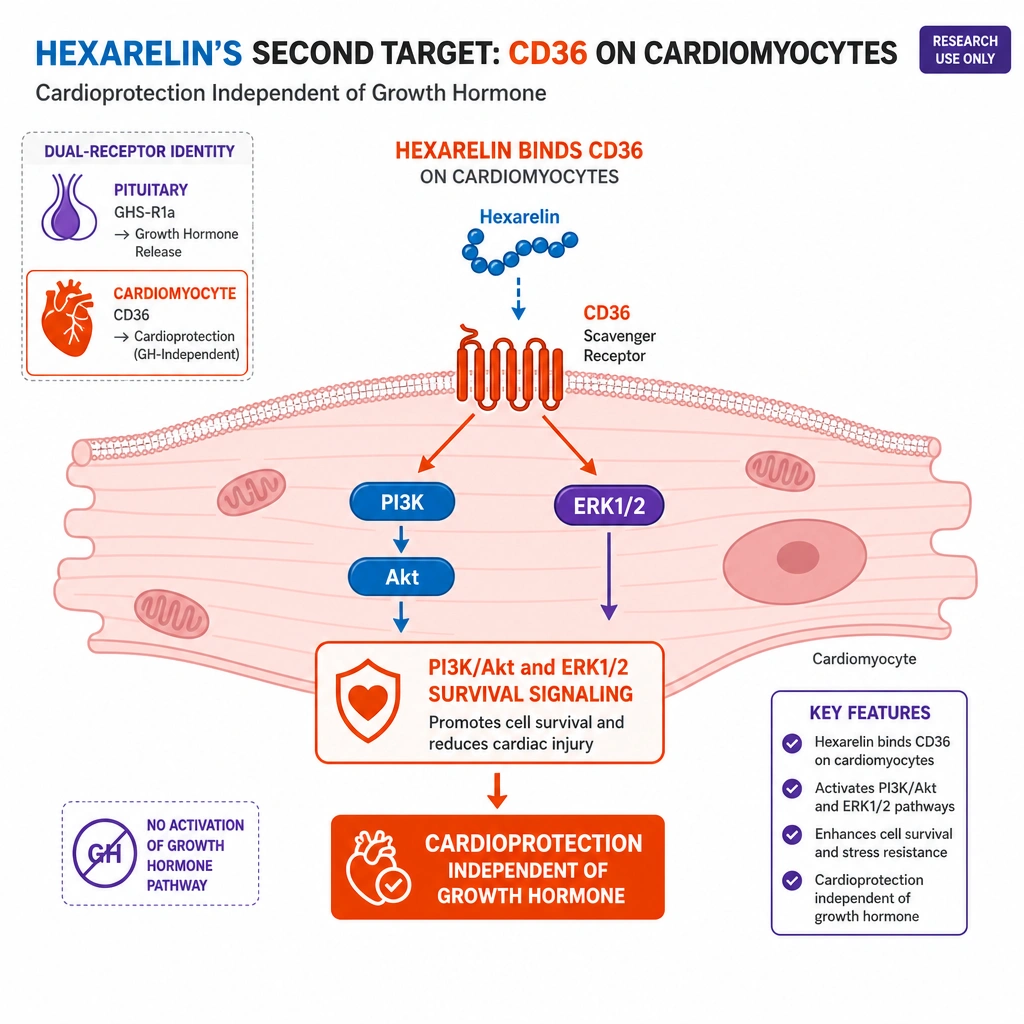
Beyond GH: Hexarelin, like GHRP-6, binds cardiac CD36 for GH-independent cardiovascular effects.
What Are CJC-1295 and Hexarelin?
Researchers studying growth-hormone regulation often pair peptides, such as Ipamorelin, GHRP-2, or Hexarelin, that engage somatotroph cells through complementary receptors. CJC-1295 (Mod GRF 1-29 or CJC-1295 no DAC, frequently supplied "with DAC" or as CJC-1295 no DAC) is a long-acting analog related to endogenous growth hormone-releasing hormone (GHRH) that engages the classical GHRH receptor. Hexarelin is a synthetic hexapeptide growth hormone secretagogue (GHS), similar in class to Ipamorelin, similar to Ipamorelin, that acts at the ghrelin receptor (GHS-R1a).
Because the two target distinct receptors on the same cells, co-exposure in culture is hypothesized to produce complementary actions — potentially altering both the amplitude and the duration of GH output relative to either peptide alone.
How Does CJC-1295 Engage GHRH Signaling?
CJC-1295 carries four amino-acid substitutions intended to extend stability and preserve a bioactive conformation, reducing susceptibility to proteolytic enzymes such as dipeptidyl peptidase-IV. The defining feature of the DAC version, per Jetté et al. (2005), is an additional C-terminal lysine bearing an Nε-3-maleimidopropionamide moiety — the "drug affinity complex" (DAC) — that tethers the peptide to albumin.
Mechanistically, GHRH-receptor engagement activates the cAMP pathway — adenylyl cyclase, cAMP, and protein kinase A (PKA) in sequence, as outlined by Culhane et al. (2015). Rising cAMP supports phosphorylation events that promote calcium entry and fusion of GH-containing vesicles, a process often studied for its downstream effects on body composition, muscle growth, fat loss, and potential anti-aging applications. Beyond acute release, GHRH-type signaling supports synthetic capacity—often associated with muscle growth in animal models: capacity and growth hormone production: in CJC-1295-with-DAC work, Alba et al. (2006) observed an "increase in total pituitary RNA and GH mRNA, suggesting that proliferation of somatotroph cells had occurred, as confirmed by immunohistochemistry."
How Does Hexarelin Engage Ghrelin/GHS-R1a Signaling?
Hexarelin is a synthetic hexapeptide with the structure His-D-2-methyl-Trp-Ala-Trp-D-Phe-Lys-NH2, and it was shown by Imbimbo et al. (1994) to stimulate GH release in a dose-responsive way, though researchers also monitor its impact on prolactin levels. Rather than a GHRH analog, it is a growth hormone secretagogue acting at GHS-R1a, often evaluated for its selectivity regarding cortisol and prolactin secretion.
Upon binding GHS-R1a, the receptor couples with Gq/11 proteins and activates phospholipase C (PLC), as reviewed by Yin et al. (2014). PLC cleaves membrane phospholipids into inositol-1,4,5-trisphosphate (IP3) and diacylglycerol (DAG). IP3 mobilizes Ca2+ from intracellular stores while DAG activates protein kinase C (PKC); the concurrent rise in cytosolic Ca2+ and PKC activity facilitates exocytosis of GH-containing granules. This PLC/IP3/PKC route is mechanistically distinct from, and potentially complementary to, the cAMP-driven pathway of GHRH analogs.
How Much Do They Raise GH and IGF-1?
GH release driven by either peptide can exceed control peaks in culture. Jetté et al. (2005) reported that in cultured anterior pituitary cells, CJC-1295 produced an approximately 4-fold increase in GH area-under-the-curve over a 2-hour window relative to hGRF(1–29).
The contrast is instructive: CJC-1295 provides a long, sustained elevation of the GH–IGF-1 axis, while Hexarelin contributes a sharper secretagogue pulse. That difference in kinetics is exactly why the two are studied as a pair.
Is the CJC-1295 + Hexarelin Combination Synergistic?
To date there appear to be no published experiments on the specific CJC-1295 + Hexarelin pairing. However, the literature has examined blends of Hexarelin with GHRH and related GHRH analogs (from which CJC-1295 is derived), and the most directly relevant data come from Arvat et al. (1997).
This pattern fits the broader literature suggesting GHRH and GHS co-exposure may be supra-additive — an effect generally attributed to the convergence of two distinct receptor pathways (cAMP/PKA for the GHRH receptor and PLC/IP3/PKC for GHS-R1a) acting on the same somatotroph cells. It is the mechanistic basis for pairing a long-acting GHRH analog like CJC-1295 with a secretagogue like Hexarelin in research designs.
Does Hexarelin Act Beyond GH via Cardiac CD36?
One of the most interesting features of Hexarelin is that it does not act only through GHS-R1a. Work by Bodart et al. (2002, Circulation Research) identified CD36 — a multifunctional scavenger-receptor glycoprotein expressed on cardiomyocytes and microvascular endothelium — as a binding protein mediating the cardiovascular actions of growth-hormone-releasing peptides in the heart.
Complementing this, work in isolated cell systems (consistent with the framework of Sun et al., 2010) reported that Hexarelin and ghrelin act on cardiomyocytes through GHS-R1a and protein-kinase signaling, with survival pathways such as PI3K/Akt and ERK1/2 implicated in protection from ischemia-reperfusion injury; GHS-R antagonists abolished the GHS-R1a-dependent component. In short, Hexarelin has a pituitary job (GH release) and a separate cardiac one (CD36-mediated), and researchers keep the two clearly distinguished.
| Feature | CJC-1295 (Mod GRF 1-29 + DAC) | Hexarelin |
|---|---|---|
| Class | Long-acting GHRH analog | Growth hormone secretagogue (GHS) |
| Primary receptor | GHRH receptor | Ghrelin / GHS-R1a |
| Signaling pathway | cAMP → PKA | PLC → IP3/DAG → Ca2+/PKC |
| Stability feature | DAC albumin tether (~5.8–8.1 day half-life) | Hexapeptide; shorter, pulsatile action |
| Reported GH effect | ~4× GH AUC; days-long elevation | Strong acute secretagogue pulse |
| Extra-pituitary target | — | Cardiac CD36 (GH-independent) |
How is research-grade CJC-1295 / Hexarelin characterized?
Both peptides carry non-standard features (CJC-1295's DAC modification; Hexarelin's D-amino acids), so identity confirmation is essential. Research-grade material is typically verified by reversed-phase HPLC for purity and mass spectrometry for identity, handled cold, and supplied for laboratory use only. At PrymaLab, research peptides are characterized with HPLC/MS verification and independent third-party testing. No specific lot data are asserted in this general reference.
Frequently Asked Questions
What are CJC-1295 and Hexarelin?
CJC-1295 (Mod GRF 1-29, often with DAC) is a long-acting GHRH analog engaging the GHRH receptor; Hexarelin is a hexapeptide growth hormone secretagogue acting at ghrelin/GHS-R1a. Both are research use only.
How does CJC-1295 work?
Substitutions plus a DAC group that tethers it to albumin extend its half-life beyond 72 hours (~5.8–8.1 days). It activates the GHRH receptor via cAMP/PKA and, per Alba et al., increases GH mRNA and somatotroph proliferation.
How is Hexarelin different?
Hexarelin binds GHS-R1a, coupling to Gq/11 and PLC to generate IP3 and DAG, raising calcium and activating PKC for GH-granule exocytosis — a pathway distinct from CJC-1295's cAMP/PKA route.
Is combining them synergistic?
No study of the exact pairing exists, but Arvat et al. found GHRH + Hexarelin gave a GH AUC (~4,259 µg/L·h) exceeding the sum of each alone (~2,200 + ~792), consistent with two converging receptor pathways.
Does Hexarelin act outside the pituitary?
Yes. It binds cardiac CD36, and Bodart et al. reported CD36-mediated cardiovascular effects that appear largely GH-independent, occurring even in GH-deficient models.
Are they approved for human use?
No. Both are research-use-only peptides studied in cell and animal models and are not intended for human or veterinary use.
References
- Jetté L, Léger R, Thibaudeau K, et al. Human growth hormone-releasing factor (hGRF)1-29-albumin bioconjugates activate the GRF receptor on the anterior pituitary in rats: identification of CJC-1295 as a long-lasting GRF analog. Endocrinology. 2005;146(7):3052–3058. PMID:15817669
- Culhane KJ, Liu Y, Cai Y, Yan ECY. Transmembrane signal transduction by peptide hormones via family B G protein-coupled receptors. Front Pharmacol. 2015;6:264. PMC4633518
- Alba M, Fintini D, Sagazio A, et al. Once-daily administration of CJC-1295, a long-acting GHRH analog, normalizes growth in the GHRH knockout mouse. Am J Physiol Endocrinol Metab. 2006;291(6):E1290–E1294. PMID:16822960
- Imbimbo BP, Mant T, Edwards M, et al. Growth hormone-releasing activity of hexarelin in humans. A dose-response study. Eur J Clin Pharmacol. 1994;46(5):421–425. PMID:7957536
- Yin Y, Li Y, Zhang W. The growth hormone secretagogue receptor: its intracellular signaling and regulation. Int J Mol Sci. 2014;15(3):4837–4855. PMC3975427
- Bodart V, Febbraio M, Demers A, et al. CD36 mediates the cardiovascular action of growth hormone-releasing peptides in the heart. Circ Res. 2002;90(8):844–849. PMID:11988484
- Sun Q, Ma Y, Zhang L, et al. Effects of GH secretagogues on contractility and Ca2+ homeostasis of isolated adult rat ventricular myocytes. Endocrinology. 2010;151(9):4446–4454. doi:10.1210/en.2009-1432
- Teichman SL, Neale A, Lawrence B, et al. Prolonged stimulation of growth hormone (GH) and insulin-like growth factor I secretion by CJC-1295, a long-acting analog of GH-releasing hormone, in healthy adults. J Clin Endocrinol Metab. 2006;91(3):799–805. PMID:16352683
- Arvat E, Di Vito L, Gianotti L, et al. Mechanisms underlying the negative growth hormone (GH) autofeedback on the GH-releasing effect of hexarelin in man. Metabolism. 1997;46(1):83–88. PMID:9005975
Final disclaimer: This article is an educational research reference. CJC-1295 and Hexarelin are sold and studied for laboratory research use only, are not approved by any regulatory authority, and are not intended for human or veterinary use. Statements have not been evaluated by the FDA. Nothing here should be interpreted as medical advice or as a claim of efficacy or safety in humans.
Mechanistic descriptions combine in-vitro, animal, and clinical observations that may not generalize; the specific CJC-1295 + Hexarelin combination is inferred from related GHRH+GHS data, not a direct study. Always verify the legal status of any research compound in your jurisdiction before purchase or use.